Lab 01 / Systems & number theory
A Prime Search That Skipped a Prime
An OpenMP race condition, a fairer benchmark, and primality shortcuts put to the test.
Fixing an OpenMP race condition, re-running a biased benchmark, and testing three prime shortcuts until they broke.
Systems & Number Theory Postmortem · Research directories: prime-research-v2, prime-linear-research
We started this project trying to speed up multi-threaded probable-prime search on 1,024- to 4,096-bit integers, and to check whether polynomial or binomial identities could filter composites faster than standard Baillie-PSW (BPSW) testing. The first draft of our report claimed a 35% to 52% parallel speedup and floated a complexity-theoretic path toward sub-quadratic primality testing.
An adversarial code audit and a round of counterexample searches overturned both claims. The parallel search had an OpenMP scheduling bug that could skip the true next prime when a strong base-2 pseudoprime sat ahead of it. The 35% to 52% speedup came from comparing a 12-thread shared-tree sieve against a single-threaded baseline that rebuilt its remainder state on every call. And our favorite polynomial filter, which rejected every odd composite up to 5,000, failed at 3,215,031,751.
This report documents the bug, the repaired algorithm, the corrected 12-thread benchmark, and the counterexamples that closed off the mathematical shortcuts.
1. How a base-2 pseudoprime caused OpenMP workers to skip 42,821
Given a starting integer N, parallel_next_prime searches upward through odd offsets for the smallest Baillie-PSW probable prime N + δ. Candidates that survive a small-prime wheel and a shared remainder-tree sieve are stored in an ordered array survivors[0 .. K-1] and distributed across OpenMP threads. Each candidate undergoes a two-stage BPSW test: a base-2 strong probable-prime (Miller-Rabin) test followed by a strong Lucas probable-prime test.
To avoid wasted Lucas tests once a smaller index looked promising, the original implementation maintained two shared atomic integers: best_provisional (set when a candidate passed base-2 Miller-Rabin) and best_confirmed (set after the candidate also passed strong Lucas). Before testing index idx, each worker checked:
if (idx > best_confirmed || idx > best_provisional) continue;
When the candidate at best_provisional is a composite strong base-2 pseudoprime (SPRP-2), it passes base-2 Miller-Rabin and fails strong Lucas, but any worker that checks the gate in the meantime abandons its index permanently. At N = 42,798 (B = 53, W = 64), four candidates survive the sieve: 42,799, 42,821, 42,827, and 42,829.
| Slot | Candidate | Arithmetic status | Thread action under the buggy gate |
|---|---|---|---|
| 0 | 42,799 | 127 × 337 (base-2 pseudoprime) | Worker 0 passes base-2 Miller-Rabin, sets best_provisional = 0, then fails strong Lucas. |
| 1 | 42,821 | Prime (true next prime) | Worker 1 sees idx 1 > best_provisional (0) at loop entry and exits without testing. |
| 2 | 42,827 | 113 × 379 (composite) | Worker 2 sees idx 2 > best_provisional (0) at loop entry and exits without testing. |
| 3 | 42,829 | Prime (returned in error) | Worker 3 entered before Worker 0 wrote best_provisional, finishes BPSW, and sets best_confirmed = 3. |
Table 1. Four-worker execution trace at N = 42,798 (B = 53, W = 64). Because 42,799 is 127 × 337 (a strong base-2 pseudoprime), its temporary provisional bound causes Workers 1 and 2 to abandon slots 1 and 2 while Worker 3 confirms 42,829.
Fixing the gate and verifying the schedule
Removing best_provisional entirely would give up early cancellation, while keeping it as an irrevocable skip is unsafe. In prime-research-v2/src/algorithms.cpp, we added a per-slot byte array resolved[K] initialized to zero. Whenever a worker finishes evaluating slot idx (whether it fails base-2 Miller-Rabin, fails strong Lucas, or passes both), it writes resolved[idx] = 1. After the OpenMP parallel loop hits its barrier, the calling thread scans every index 0 <= idx < best_confirmed in increasing order and runs full BPSW on any slot with resolved[idx] == 0.
If the lowest-index survivor is prime, best_confirmed reaches 0 and the post-barrier repair loop does zero work. If a composite SPRP-2 temporarily suppresses an intermediate prime slot, the repair pass tests that unresolved slot before returning. We added tests/scheduled.cpp, which uses custom synchronization barriers to force the exact four-worker interleaving in Table 1 and verifies that parallel_next_prime(42798) returns 42,821.
Six additional defects caught during the audit
While auditing the concurrency bug, we reviewed the surrounding sieve, modular arithmetic, and certificate code and fixed six other correctness problems:
- Sieve-only status code: Calling
test_candidatewithrun_prp = falsereturnedDEFINITELY_COMPOSITEfor any survivor that passed the sieve, misclassifying the prime 101. We added an explicitUNDETERMINEDstatus. - 65-bit Barrett quotient truncation: In
BarrettNearContext, near-power-of-two moduli such as N = 2¹²⁷ with δ = 2 overflowed a 64-bit high word during quotient estimation. Retaining the 65th bit fixed the modular reduction. - Negative Pocklington targets: The Pocklington-Lehmer certificate verifier did not check N > 2, allowing negative inputs such as N = -3 to pass verification.
- Unchecked certificate construction: The Pocklington builder previously emitted certificates without verifying that the factored part F actually divided N - 1 or running self-verification before returning success.
- Unbounded factoring recursion: When Pollard rho and trial division failed to split a composite cofactor,
factor_completelyrecursed on the same unsplit value until it blew the call stack. - Hardcoded wheel primes:
SegmentSievealways filtered by primes up to 53 even when the caller requested a smaller sieve bound B < 53.
2. Re-running the benchmark against matched 12-thread baselines
Our original benchmark reported that the two-stage search was 35% to 52% faster than a standard GMP baseline. When we inspected the harness, we found two confounding differences: the candidate search ran on 12 OpenMP threads with a prebuilt remainder tree, whereas the baseline ran on a single thread and rebuilt its grouped prime-product remainders inside every call to next_prime.
To measure what two-stage cancellation actually contributes, we built three 12-thread baselines in prime-research-v2/tests/matched_benchmark.cpp that share the exact same thread count, sieve bounds (B = 65,536 at 1,024 bits; 262,144 at 2,048 bits; 4,194,304 at 4,096 bits), and search windows:
- Grouped remainder + GMP24: 12 OpenMP threads using grouped prime-product trial remainders and
mpz_probab_prime_p(..., 24). (In GMP 6.3, 24 reps runs a single BPSW pass because the routine loopsreps - 24additional Miller-Rabin rounds.) - Shared tree + Custom BPSW: 12 OpenMP threads using the same prebuilt
PrimeForestremainder tree as our algorithm, paired with an atomicbest_idxcutoff and our custom full BPSW implementation. - Shared tree + GMP24: 12 OpenMP threads using the shared
PrimeForestremainder tree, an atomicbest_idxcutoff, and GMP'smpz_probab_prime_p(..., 24).
We generated 12 held-out starting integers per bit width from an independent random seed, and ran all four methods 3 times per input in randomized order on a 12-thread AMD Ryzen 5 4600H (GCC 15.2, GMP 6.3, 432 total measurements).
| Bit width | Method (12 OpenMP threads) | Mean (ms) | Median (ms) | Speedup vs. Tree+GMP24 |
|---|---|---|---|---|
| 1,024 bits | Grouped remainder + GMP24 | 4.31 | 3.10 | 0.94× |
| 1,024 bits | Shared tree + Custom BPSW | 5.14 | 4.53 | 0.79× |
| 1,024 bits | Shared tree + GMP24 | 4.05 | 3.51 | 1.00× (baseline) |
| 1,024 bits | Repaired two-stage search | 3.59 | 2.79 | 1.13× [1.05, 1.23] |
| 2,048 bits | Grouped remainder + GMP24 | 31.41 | 30.86 | 0.94× |
| 2,048 bits | Shared tree + Custom BPSW | 33.44 | 31.00 | 0.89× |
| 2,048 bits | Shared tree + GMP24 | 29.63 | 28.64 | 1.00× (baseline) |
| 2,048 bits | Repaired two-stage search | 24.85 | 25.37 | 1.19× [1.09, 1.31] |
| 4,096 bits | Grouped remainder + GMP24 | 302.21 | 200.99 | 0.95× |
| 4,096 bits | Shared tree + Custom BPSW | 306.27 | 203.07 | 0.94× |
| 4,096 bits | Shared tree + GMP24 | 288.17 | 185.72 | 1.00× (baseline) |
| 4,096 bits | Repaired two-stage search | 261.63 | 160.54 | 1.10× [1.04, 1.19] |
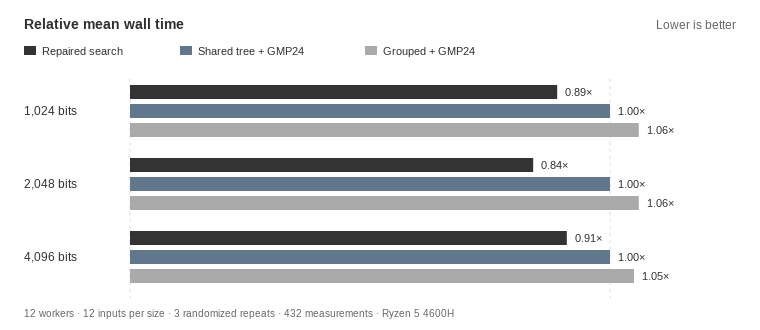
Table 2 & Figure 1. Held-out 12-thread benchmark across 12 inputs × 4 methods × 3 randomized repeats per bit width (432 runs). Bracketed intervals show 95% paired bootstrap confidence intervals for the ratio of mean wall times against Shared tree + GMP24.
What the corrected numbers mean (and their caveats)
Once all four methods get 12 threads and the same remainder tree, the gap narrows from the overstated 35% to 52% claim to a consistent 9.2% to 16.1% reduction in mean wall time (1.10× to 1.19× speedup over Shared tree + GMP24). Two measurement caveats matter when interpreting Table 2:
- Warm-query vs. cold-start cost: Table 2 measures steady-state queries after
PrimeForestis constructed. Building the 4,096-bit remainder tree takes roughly 48.8 ms up front, which pays off across batches of queries rather than one-shot calls. - Complete query paths: The pool baselines construct per-window survivor metadata slightly differently from the integrated two-stage search, so the 1.10× to 1.19× figure reflects the complete query routine rather than Lucas cancellation in isolation.
3. Testing three mathematical prime shortcuts until they broke
Alongside the systems work, we built an executable testbed (prime-linear-research/experiments.py) to check whether low-degree polynomial rings, binomial coefficients, or small-prime residue fingerprints could act as ultra-fast deterministic prime filters or reduce the cost of testing record-sized numbers.
The 3-ring polynomial identity fails at 3,215,031,751
The Agrawal-Kayal-Saxena (AKS) theorem proves that N is prime if and only if (X + a)ᴺ ≡ Xᴺ + a (mod N, Xʳ - 1) holds for an order parameter r = O(log⁵ N) and enough linear offsets a. Because working in a ring of degree log⁵ N is much slower than Miller-Rabin, a natural temptation is to fix a tiny set of quotient rings such as r in {2, 3, 5} with a = 1.
Tested sequentially on all 1,831 odd composites in [3, 5000], the 3-ring check (X + 1)ᴺ ≡ Xᴺ + 1 (mod N, Xʳ - 1) for r in {2, 3, 5} produces zero false positives. A test script that only scans small integers makes the 3-ring shortcut look exact. When we fed it known strong pseudoprimes, however, the 14th candidate in our list (N = 3,215,031,751 = 151 × 751 × 28,351) passed all three rings as well as strong probable-prime tests to bases 2, 3, 5, and 7.
Why does 3,215,031,751 slip through? In the quotient ring mod (N, Xʳ - 1) for small r, the polynomial identity only constrains the multiplicative order of N modulo the prime factors of r and cyclotomic cosets of size dividing r. Whenever each prime factor p | N satisfies p ≡ 1 (mod lcm(2, 3, 5)) or aligns with the Frobenius action on those three tiny rings, the congruence holds mod every p | N and therefore mod N. Here 151 ≡ 751 ≡ 28,351 ≡ 1 (mod 30), so multiplication by p acts identically to the prime Frobenius map in all three rings.
Why Pascal-row divisibility is trial division in disguise
A second classic criterion states that N is prime if and only if N divides the binomial coefficient C(N, k) for every 1 <= k <= N - 1. Since checking all N - 1 coefficients is exponential in the bit length of N, we tested whether checking only the first B coefficients could detect composites early.
Across all 4,330 composites in [4, 5000], the first index k where C(N, k) ≠ 0 (mod N) was always the exact least prime factor of N. That happens because of the elementary identity:
C(N, p) = (N / p) · C(N - 1, p - 1)
with C(N - 1, p - 1) ≡ (-1)^(p-1) ≡ 1 (mod p).
When p is the smallest prime dividing N, every integer 1 <= j < p is invertible mod N, so N divides C(N, k) for all k < p and fails at k = p because the factor of p in the denominator cancels a factor of p in N. Checking C(N, k) mod N for 1 <= k <= B therefore catches the exact same composites as trial division up to B, while doing more arithmetic per step.
Residue collisions and the 40-million-digit squaring wall
We also checked whether combining small-prime residues with binary representation features (bit length and Hamming weight) could separate primes from composites without full modular exponentiation. By the Chinese Remainder Theorem, residues mod 2, 3, 5, 7, 11, and 13 only determine N mod 30,030. In our scan, the prime 1,500,007 and the 3-prime composite 1,740,247 = 31 × 73 × 769 share identical residues [1, 1, 2, 5, 3, 2], identical bit length (21 bits), and identical popcount (13 one-bits).
Finally, we estimated the arithmetic wall for testing a 40-million-decimal-digit general integer (roughly b ≈ 1.33 × 10⁸ bits, comparable to the largest known Mersenne primes). General Fermat or Miller-Rabin testing requires Θ(b) modular squarings of b-bit numbers. Even with FFT multiplication running at ~0.1 seconds per 133M-bit squaring, executing 1.33 × 10⁸ sequential squarings takes roughly 1.33 × 10⁷ seconds (~154 days) on a single core. Record Mersenne searches avoid this only because N = 2ᵖ - 1 has a fixed weight-2 binary structure and an explicit group order structure enabling the Lucas-Lehmer test and fast mod-(2ᵖ - 1) folding.
| Proposed shortcut | Small-range behavior | Why it fails in general |
|---|---|---|
| Quotient rings (X+1)ᴺ ≡ Xᴺ + 1 mod (N, Xʳ - 1) for r in {2, 3, 5} | 0 false positives across all 1,831 odd composites in [3, 5000]. | Composite 3,215,031,751 = 151 × 751 × 28,351 passes all three rings (and strong PRP bases 2, 3, 5, 7). |
| Pascal row divisibility: check C(N, k) ≡ 0 mod N for 1 <= k <= B | Rejects every composite in [4, 5000] at its exact least prime factor k = lpf(N). | Since C(N, p) = (N/p) C(N-1, p-1) with C(N-1, p-1) ≡ 1 mod p, checking k <= B is trial division up to B. |
| Small-prime residue and bit-shape fingerprint | Filters candidates divisible by 2, 3, 5, 7, 11, or 13. | Prime 1,500,007 and composite 1,740,247 = 31 × 73 × 769 share residues [1, 1, 2, 5, 3, 2], bit length (21), and popcount (13). |
| 40M-digit exponentiation via log₂(N) squarings | Fast at 1,024 to 4,096 bits. | At 133M bits, 133M modular squarings times ~0.1 s per FFT multiply takes ~154 days on one core. |
Table 3. Summary of the four mathematical hypotheses tested in prime-linear-research/experiments.py and the exact counterexamples or complexity bounds that ruled them out.
4. Reproducing the tests and benchmarks
Both research directories in the repository are self-contained and reproducible from the command line:
- Run the unit, adversarial, and deterministic barrier schedule tests: in
prime-research-v2, build with CMake and runtest_correctness,regression, andscheduled_regression. - Re-run the 432-run held-out 12-thread ablation benchmark: run
matched_benchmarkinprime-research-v2, which writes raw timings toresults/holdout-ablation.csvand paired bootstrap intervals toresults/summary.txt. - Re-generate the mathematical counterexamples: run
python prime-linear-research/experiments.py, which reproduces the 3,215,031,751 3-ring failure, the Pascal-row least-prime-factor identity, and the 1,500,007 / 1,740,247 collision.
HTML edition of the complete 5-page report. Tables and formulas have been reformatted for the web; the chart is redrawn from the report’s values. Download the original PDF